Find us here
Corporate App Development Costs: What Determines the Price in 2025?

Admin

Many companies today are investing in applications to support operations, enhance customer service, and accelerate business growth. But before starting a project, one question always comes up:
“How much does it cost to build a corporate application in 2025?”
There is no single answer, because every company has different needs, workflows, and levels of complexity. However, several key factors always determine the total development cost.
Below is a clear and easy-to-understand explanation.
1. Feature Complexity
Features are the most significant cost driver.
The more complex the features, the more time and development effort required.
Examples:
-
Simple form input → low cost
-
Reporting with filters → medium
-
Payment gateway integration → medium–high
-
GPS-based attendance system → high
-
Real-time analytics dashboard → very high
The more automation needed, the longer the development timeline—and the higher the cost.
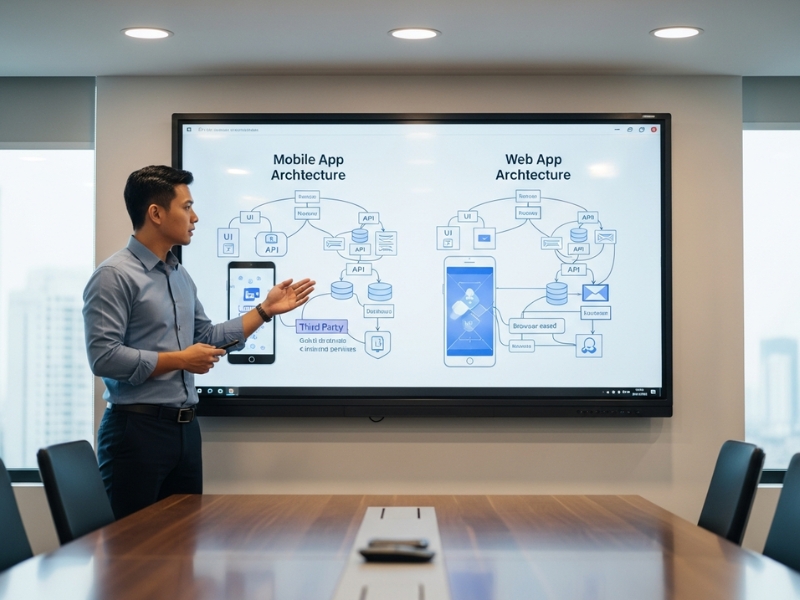
2. Platform Choice: Android, iOS, or Web App
Choosing the right platform impacts cost significantly.
Typical cost order from cheapest to most expensive:
Web App → Android → iOS → Android + iOS + Web (complete package)
If a company needs the application to run across all devices, the cost increases due to additional development and testing work.
3. UI/UX Design Requirements
Companies often want UI/UX that is:
-
professional and modern
-
easy for employees to use
-
aligned with brand identity
-
simple for non-technical users
The more detailed and interactive the design, the more design hours required—directly affecting total cost.
4. System Integration Needs
Corporate applications rarely stand alone.
They often need to integrate with:
-
HR systems
-
inventory systems
-
ERP solutions
-
internal APIs
-
legacy databases
Integration requires careful handling to ensure data security, synchronization stability, and system performance.
The more integrations required, the higher the overall cost.
5. Application Security Requirements
Companies—especially those in sensitive industries—require strong security.
Security often contributes significantly to the total project cost.
Advanced security features may include:
-
data encryption
-
audit logs
-
two-factor authentication (2FA)
-
role-based access
-
penetration testing
Industries like finance, logistics, healthcare, and government usually require higher security standards.
6. Maintenance & Continuous Development
After the application is launched, companies still need:
-
regular updates
-
bug fixes
-
feature adjustments
-
performance optimization
For this reason, vendors typically offer monthly or yearly maintenance packages.
7. Vendor Experience
More experienced vendors may charge higher fees—but deliver:
-
clearer timelines
-
more stable architecture
-
better security
-
lower project risk
A cheaper vendor isn't always more economical.
For corporate systems, stability and scalability matter, making the right vendor a long-term investment.
Need an Accurate Cost Estimate for Your Company’s App?
If you want a more precise estimate based on your company’s requirements, you can consult directly with the Wiradipa team. They have extensive experience building applications for enterprises and startups across various industries.
👉 Free consultation via WhatsApp: Contact Wiradipa
Explore the complete list of services:
https://wiradipa.com/layanan
Final Thoughts
The cost of building a corporate application in 2025 depends on multiple factors: features, design, integration, security, and the chosen platform. Each company has unique requirements, so the best way to get an accurate estimate is to discuss your needs with a professional vendor.
If you're planning a digital project this year, the first step is to understand your business needs clearly—then consult an experienced software house to get a realistic price range.
You can start your first discussion with the Wiradipa team anytime via WhatsApp.
Recent Articles




Featured Articles






































































.jpg)